Introduction: More than Places, More than Technology
The future of the travel industry will not be determined by technology alone. Many travel platforms will soon be technically perfect, and their content can be generated in infinite quantity by AI. However, most offerings remain limited to rather superficial travel tips. The decisive question is: How can travel content retain meaning, depth, and inspiration in a world flooded by mass production?
The answer lies in a philosophy that understands travel as a path of transformation—not merely a sequence of destinations. The Nine Doors of Travel Philosophy shows this path. It connects classical tradition (wisdom), philosophical meaning structures, and modern AI intelligence into a framework for qualitative content.
The Nine Doors: Structure and Meaning
The philosophy is divided into three levels, guiding travelers from the inner to the outer and finally into the social dimension:
- Inner (Doors 1–3): Metamorphosis, Transformation, Intuition – travel as self-exploration.
- Outer (Doors 4–6): Constellation, Transaction, Resonance – travel as resonance with places, people, cultures.
- Social (Doors 7–9): Alone, Couples, Groups – travel as relationship and community experience.
Each door unfolds into three aspects, resulting in 27 dimensions of travel. This matrix becomes an ordering principle for content that does not restrict diversity but charges it with meaning.
The Library: Tradition as a Foundation
The Nine Doors are not arbitrary; they are rooted in our real library of world literature. Three works are elemental:
- Homer, Odyssey – archetype of adventurous and transformative travel.
- Goethe, Italian Journey – self-discovery through culture, art, and nature.
- Ibn Battuta, Life’s Journey – encounter with the world as a social and intercultural fabric.
Thus, the three levels of the Nine Doors (Inner, Outer, Social) are both literary and philosophical in origin. The library provides wisdom, the philosophy provides the guiding thread, and AI updates both.
A Concrete Example: Door 2 – Transformation
To make the philosophy tangible, let us look at Door 2 – Transformation, inspired by Goethe’s Italian Journey and updated through a modern trip to Sicily.
For Goethe, Sicily was the “key to everything.” Here, he connected with the Greek virtues that shaped transformation: Courage, Attention, Gratitude.
On a contemporary journey to Sicily, these virtues came alive again:
- Courage in leaving the beaten path and exploring remote villages.
- Attention in moments of silence at the ancient temple of Agrigent, simply listening to wind and stone.
- Gratitude in encounters with locals, sharing meals and hospitality.
A modern resonance path might look like this:
- Practice courage: choose an unplanned stop or a place off the tourist map.
- Practice attention: set aside an hour without devices—just sensing and writing a single sentence in a travel journal.
- Practice gratitude: end the day by noting three things you are thankful for.
Reflection question: “Which virtue has my journey awakened most strongly—and how can I carry it into daily life?”
This shows how the Nine Doors turn tradition and philosophy into living experiences.
AI as Amplifier: From the General to the Specific—and Back Again
Artificial intelligence in this architecture is not a substitute for human thought or experience but an amplifier:
- It analyzes sources, contextualizes ideas, and enables new content.
- It fills the 27 aspects of the Nine Doors with stories, inspiration, and experiential knowledge.
- It transforms the philosophy into a living content system that moves from the general to the specific—and back again through feedback.
This creates a dynamic cycle: content grows infinitely without losing its structure of meaning. Many travel destinations thus become part of a deeper experience.
Future of Content: Architecture of Resonance
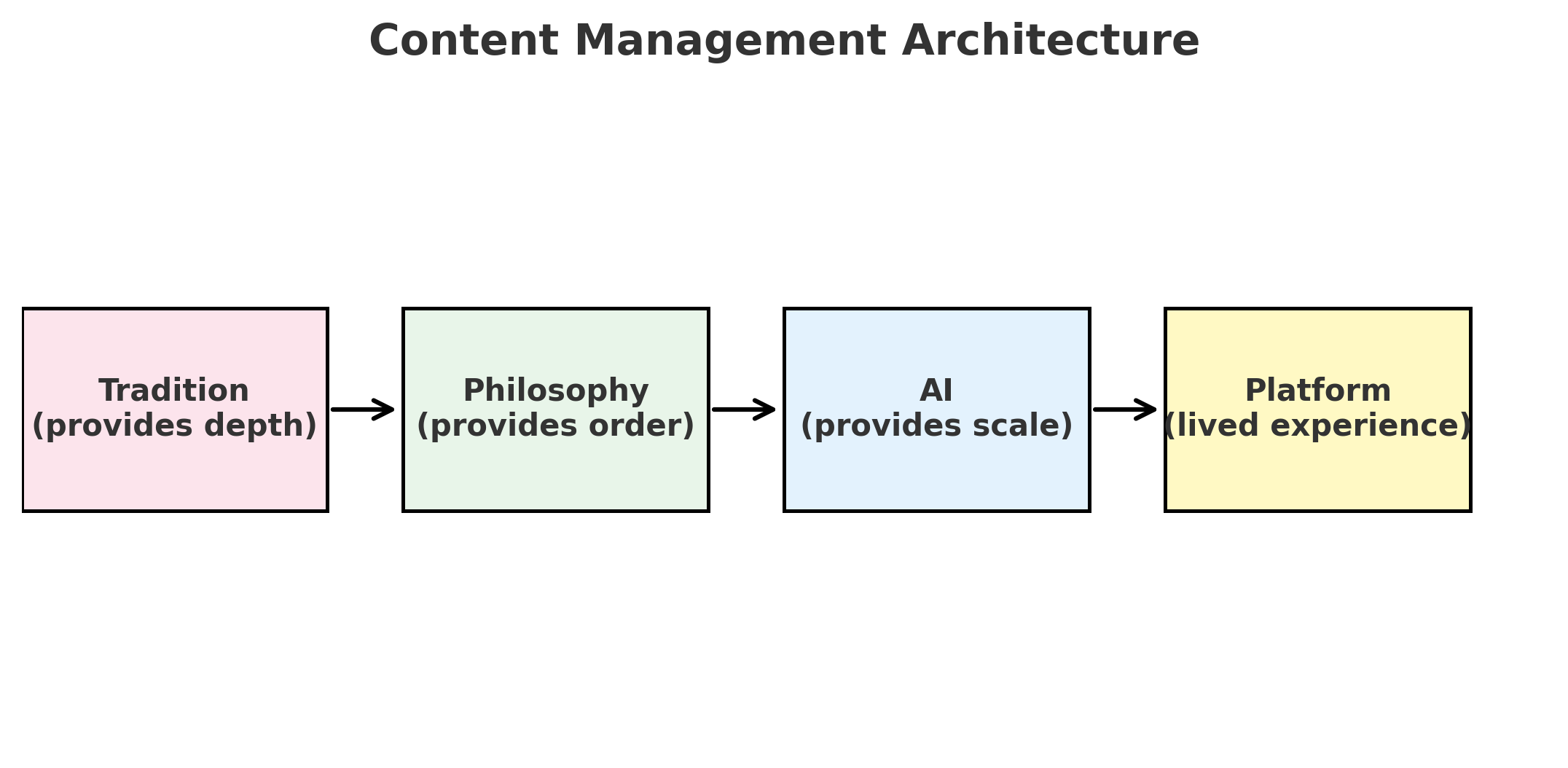
What makes this philosophy unique is its function as a content management architecture:
- Tradition provides depth.
- Philosophy provides order.
- AI provides scalability.
- The platform provides lived experience.
Content is therefore not isolated but enters into resonance—with literature, art, nature, places, people, and communities. The result is a content universe that is both quantitatively infinite and qualitatively coherent.
Conclusion: Unity as the Goal
The Nine Doors of Travel are more than a model for travel. They are a vision for the future of content:
- A travel platform will no longer merely list destinations but reveal paths of transformation.
- The use of AI will not lead to confusion but, within a philosophical order, will unfold meaning.
- Travelers will not just collect places but experience unity—between inner, outer, and social worlds.
This is the essence of our philosophy: Travel as a path to holistic experience. Our content describes spaces of resonance. Technology serves as an amplifier of meaning, organizing the journey and linking it to the right offerings.